0,00 kr. 0

Basket

No items in the cart.

Continue to shop

History of our products

Haraldslund is a municipal institution named after Harald Jensen.

Harald Jensen was born Dec. 24, 1837 in Copenhagen as the son of Christoffer Jensen, who came from Brovst and was a blubber hawker and brandy distiller.

The history of Haraldslund

Harald Jensen's childhood

As a child, Harald loved to draw and paint. At the age of 14, he was apprenticed as a painter and graduated 5 years later. But Harald wanted to be a painter and was admitted to the Academy of Fine Arts in 1857. Harald had paintings included in the Charlottenborg exhibitions. His father, who had bought Gjeddes brænderi Vesterågade 19-21 in Aalborg around 1860, was against his son's artistic dreams. So he made a deal with his son: Harald could become an artist if he won first place at an exhibition organized by Master Painter Neuhausen, Copenhagen. Harald became no. 2

The brandy

In 1862, Harald Jensen traveled to Aalborg. At that time there were 3 distilleries left in the city. To educate himself, Harald read specialized literature, especially chemistry had Harald's interest. His biggest competitor was Isidor Henius, who was the first to develop a pure aquavit through distillation, which earned him several awards. People said of the two: "Henius runs with the medals, but Harald runs with the customers." Harald Jensen's Taffelakvavit was extremely popular and was soon christened Red Aalborg. Harald was the first to add spices to his schnapps.
The financier CF Tietgen had a vision of gathering all the country's distilleries into one company and therefore wanted to buy both distilleries. Henius sold his distillery in 1881.
Harald Jensen sold his in 1883 for the tidy sum of DKK 240,000 in cash.

West Village

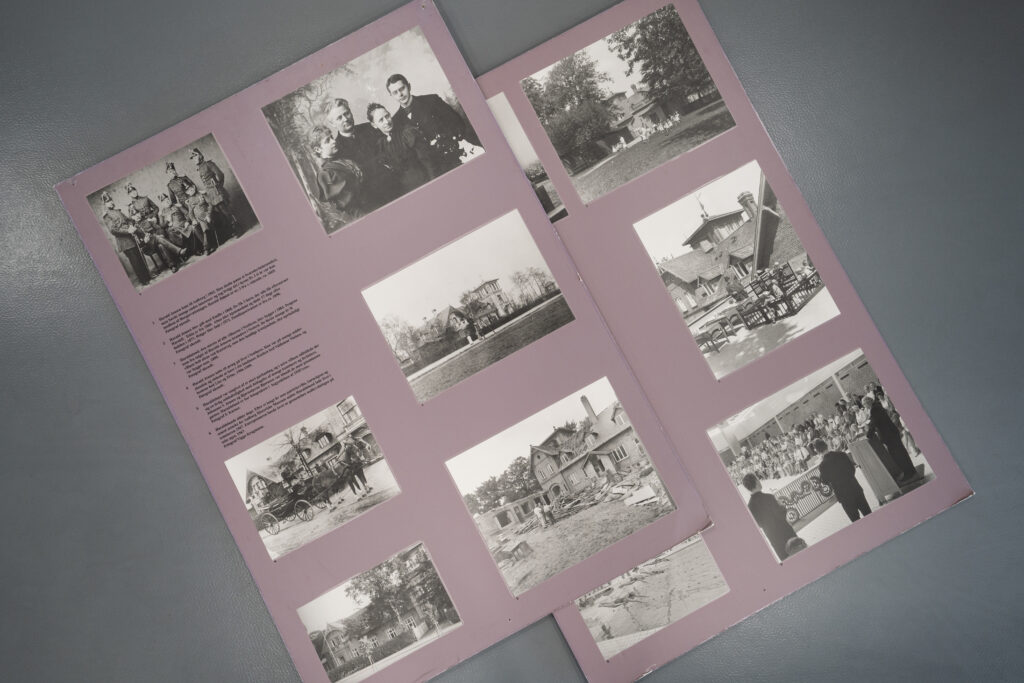
In 1880, Harald bought a significant area of land in Vestbyen. He built an American-style log house on it and enjoyed country life." In 1884, he built his mansion on this land, which he named Haraldslund. On the 6 acres of land, he created a garden, park, kitchen garden and orchard. The house was equipped with a tower where Haralds studio was located on the top floor. There were also art rooms, a coach house and a cowshed. Harald had many carriages: landau, chaise longue carriage, sleighs, etc. and a coachman.

The family had many guests, including artists such as Johs. V Jensen, Norway's national poet Bjørnstjerne Bjørnson, sculptor Jerichau etc.

Throughout his life, Harald Jensen was involved in many other projects besides his distillery business.

In 1866, 4 years after arriving in Aalborg, Harald Jensen became chairman of the local art association. He thought the city needed a museum. The current Aalborg Historical Museum was completed in 1879, partly thanks to Harald Jensen's efforts and commitment.

Naturopathic doctor

In one of the first years of Harald Jensen's time in Aalborg, one of his workers at the distillery was scalded in an accident. Harald made an ointment from butter and an egg yolk, smeared the ointment on a piece of linen, which he tied around the employee's hand. Word of the wound healer spread quickly.

After his retirement, HJ had more time to take care of the sick. Twice a week he held consultations at Haraldslund, which made him beloved by thousands. One example; Jens Torp Andersen from Egholm sought help from Harald the night before the doctors wanted to amputate his bad leg. Harald treated him and he ended up keeping his leg. A doctor in Løgstør felt offended on behalf of his profession by Harald Jensen's alternative medical practice and had him convicted of illegal quackery in 1891.

Technical School

The education of craftsmen was close to Harald Jensen's heart. That's why he joined the Technical School's board of directors in 1871. Premises intended for adult education were realized in Østerågade 8, after HJ himself had gone door to door and asked people to draw contributions for their own school building. It was also Harald Jensen who took the initiative to build a new school in Danmarksgade when the number of pupils exceeded the capacity of Østerågade. Harald Jensen was the school's chairman for 40 years.

Rural Savings Banks

Harald Jensen and 5 other well-known men founded the savings bank when the common man had difficulty obtaining loans. From 1888 - 1904, Harald Jensen was the bank's chairman.

Your family

When Harald was 31 years old, his father thought it was high time Harald got married and introduced him to Emilie Hansen, the daughter of one of his customers. The couple married in 1868 - and had three children

Tekla was born in 1869. She was frail and was baptized at home. She received no higher education but helped around the house and was responsible for 62 kerosene lamps, among other things. Alma was born in 1871 but died after 17 days. Holger was born in 1872, and was christened Holger Haraldi. Holger graduated from the Cathedral School, his grades in science were rock bottom. Like his father, he also had dreams of becoming an artist, but that didn't suit his father, so Holger continued his education at the Faculty of Theology at the University of Copenhagen. Pocket money was scarce, but if Holger needed something, all he had to do was write to his father and it would be sent to him. It was difficult for Holger to cope in the study environment and he had to give up on becoming a priest when he failed his exams. Holger then began studying law, but Holger died suddenly in 1903, aged just 29, without any previous illness. His urn was placed in the Almen Cemetery and a memorial stone was erected by his friends.

In 1907, Harald, Emilie and Hekla traveled to Norway and visited Bjørnstjerne Bjørnson. Here, 38-year-old Hekla met Bjørnson's 40-year-old son, Erling, who was divorced and a farmer. He courted Hekla and asked her to marry him. Harald said no, as he considered Erling a charlatan who was only after Tekla's inheritance, but Tekla wanted to get married. After returning home, Harald Jensen drew up his will. Tekla renounced her inheritance in exchange for a fixed annual annuity of DKK 10,000. Erling did not know this. The couple were married in 1907 without Harald and his wife Emilie present. Tekla had a son after 3 years, who was named Harald.

Harald Jensen's death and will

Harald Jensen had diabetes and circulatory disorders and died in 1914 at the age of 76.

After the funeral, the will, which was very detailed, was opened.

Harald Jensen wanted to be buried in silence. He wanted to be burned in Copenhagen and wanted no priest, no flowers but only evergreen shrubs.

Harald had bequeathed the property Haraldslund and its belongings "as a gift" to Aalborg Municipality, with the wish that it would be used for public purposes. The property was the state half-timbered villa, Haraldslund, with associated cowsheds and six acres of land, garden and park.

Aalborg stadium

Aalborg Stadium was inaugurated in 1920 and in 1927 a seated stand was added. In 1937, a standing tribune was added to increase the capacity to 3,000 spectators.
In June 1960, the tribune unfortunately burned down and a new Aalborg Stadium saw the light of day in 1962 at a match between Aalborg City Team and the Gothenburg Alliance with over 14,000 spectators at the match, who came not least to see a match in electric light, which many northerners had not experienced at this time.
In the spring of 2002, a completely new and rebuilt Aalborg Stadium was inaugurated with a two-storey north stand and a host of changes to many of the other stands.
In the fall of 2007, Aalborg Stadium was renamed Energi Nord Arena and from March 2012 to Nordjyske Arena. From spring 2017, the name of AaB's home ground is Aalborg Portland Park.

The children's reception center

In 1916, Aalborg Municipality built an orphanage in the patrician villa. The orphanage. After an extension with a side wing, there was room for 64 children and staff. The home was run by a nurse. Children who could not be placed in a nursing home or who had to be removed due to illness in the home could be admitted to the orphanage for a moderate fee. A children's and siblings' home was run at the address until
1967, when the patrician villa was demolished, as Aalborg Municipality decided to build a swimming pool and fitness center at the address.

The construction of Haraldslund

In 1967, the city council decided to build a swimming pool and fitness center on Haraldslund's land. The swimming pool was completed in 1969 as a neighbor to Aalborg Stadium.

In 2000 - 2002, both the swimming pool and the stadium underwent extensive and costly modernization. As part of the renovation, Haraldslund was expanded to include a gym, library, internet café and meeting rooms, and the name was changed to Haraldslund Vand- og Kulturhus.

The swimming pool was so thoroughly modernized that only the old inner walls from 1969 remain. Among other things, all the previous floors were broken up and new ones were poured in the swimming pool as well as in the changing and shower rooms. The floor of the large 25-meter pool was renewed, and two brand new pools were built - a children's pool and a warm water pool.

Although the Haraldslund villa no longer exists, the spirit of Harald Jensen is now, after well over 100 years, more vital than ever. With its range of activities, Haraldslund and Aalborg Sports Park have become an essential and growing part of everyday life for Aalborg's citizens and businesses.
About Haraldslund

Welcome to Haraldslund Water and Culture House

Dreaming of a day filled with activity, fun and relaxation? Then Haraldslund is the place for you! Our modern facilities offer experiences for the whole family, whether you're into swimming, exercise, play or wellness. Haraldslund Aquatic and Cultural Center is a municipal institution under the Health and Culture Administration, Aalborg Municipality.

Opening hours
Monday-Thursday
6:30 - 20:30
Friday
6:30 - 18:00
Saturday & Sunday
8:00 - 15:30
Address

Kastetvej 83
9000 Aalborg
Tel.: 99 31 67 50
haraldslund@aalborg.dk
CVR 29189420